Streamlining Federal Law Enforcement: The Case for Eliminating the FBI & ATF Amid Overlapping Mandates
By: The DP Show December 2, 2025With a government that should be practicing fiscal restraint and calling for government efficiency, the Federal Bureau of Investigation (FBI) and the Bureau of Alcohol, Tobacco, Firearms and Explosives (ATF) stand as cornerstone agencies under the U.S. Department of Justice (DOJ). Established to safeguard national security, combat crime, and uphold the rule of law, these organizations embody the motto of "Fidelity, Bravery, and Integrity" and focus on disrupting violent threats through targeted enforcement. Yet, as detailed in recent analyses of their operations and budgets, their expansive roles frequently intersect with those of other federal agencies, raising questions about redundancy, coordination challenges, and the true cost to taxpayers. This article examines these overlaps, weighs the implications of maintaining such structures, and argues persuasively, yet balanced, for their elimination, potentially saving billions in annual federal spending while preserving essential protections through reallocation.
The Broad Mandates of the FBI & ATF
The FBI, as the principal investigative arm of the DOJ, investigates over 200 categories of federal crimes, with priorities spanning terrorism, counterintelligence, cyber threats, violent crime, civil rights enforcement, transnational organized crime, white-collar crime, and public corruption. Its strategic goals include crushing violent crime, defending the homeland, rebuilding public trust, and ensuring organizational accountability. Complementing this, the ATF zeroes in on firearms trafficking, explosives regulation, arson investigations, alcohol and tobacco diversion, and violent crime reduction, leveraging tools like the National Integrated Ballistic Information Network (NIBIN) to trace crime guns and support joint task forces.
For Fiscal Year 2025 (FY2025), these agencies operate under a full-year continuing resolution that maintains funding at near prior-year levels: the FBI at approximately $10.674 billion (primarily for salaries and expenses, with a modest $30 million for construction) and the ATF at $1.625 billion (dominated by operational costs). Together, they account for over $12.3 billion in discretionary spending, funds drawn directly from taxpayer dollars amid ongoing debates over federal budget caps.
While these budgets support critical work, including intelligence sharing and crisis response, the agencies' missions are not siloed. Federal reviews, such as those from the Government Accountability Office (GAO), highlight how overlaps with entities like the Drug Enforcement Administration (DEA), Immigration and Customs Enforcement's Homeland Security Investigations (ICE-HSI), U.S. Secret Service (USSS), and others foster collaboration but also breed inefficiencies, including redundant investigations and fragmented resource allocation.
A Web of Overlaps: Redundancy in Action
The document outlines extensive jurisdictional intersections, managed through mechanisms like Joint Terrorism Task Forces (JTTFs) and memoranda of understanding (MOUs). However, these collaborations often mask deeper systemic issues: duplicated efforts in threat assessment, intelligence gathering, and enforcement, which strain budgets.
Consider the following key areas of overlap, drawn from interagency protocols
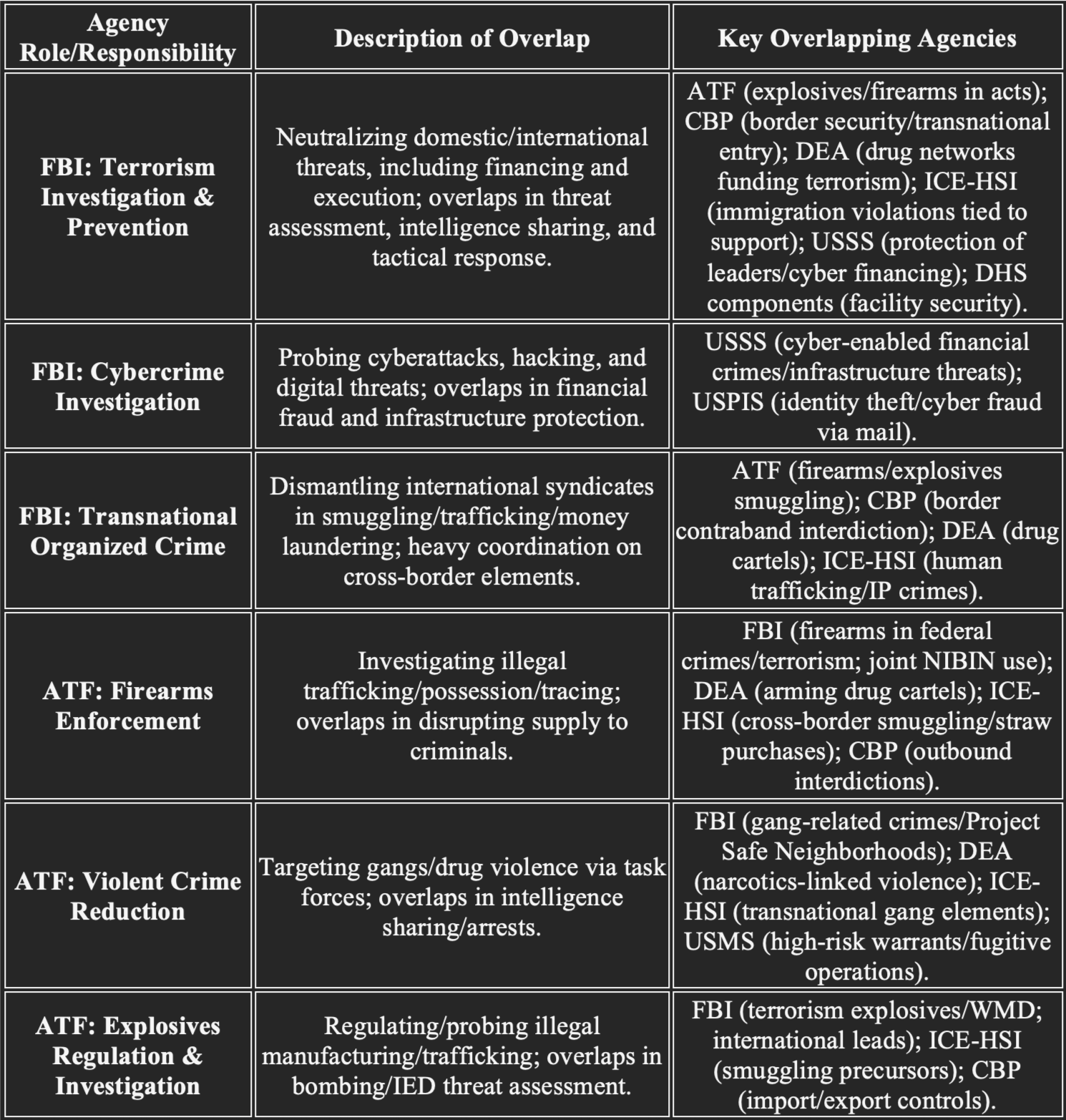
These examples illustrate a pattern: In counterterrorism, the FBI's JTTFs overlap with DHS fusion centers in analytical activities, leading to parallel data collection. Similarly, ATF's Crime Gun Intelligence Centers integrate with FBI and DEA efforts on mass shootings, yet GAO reports note persistent challenges in field intelligence sharing, such as redundant surveillance or delayed handoffs. Public corruption probes by the FBI intersect with IRS Criminal Investigation (CI) on tax evasion trails, while ATF's arson investigations dovetail with FBI leads on insurance fraud tied to federal crimes.
Proponents of the status quo argue these overlaps enable specialized expertise, e.g., ATF's ballistic tracing complements FBI cyber forensics—and have yielded successes, like over 10,000 annual felon-in-possession prosecutions via Project Safe Neighborhoods. Collaboration, they contend, amplifies impact without full duplication. However, critics, including fiscal watchdogs, point to evidence of "redundant efforts" in federal reviews, where agencies compete for leads or resources, inflating administrative costs and slowing responses. In a post-pandemic landscape of rising national debt (now exceeding $35 trillion), such inefficiencies warrant scrutiny: Why maintain two DOJ behemoths when streamlined alternatives could suffice?
The Persuasive Case for Elimination: Efficiency, Accountability, & Savings
Eliminating the FBI and ATF would not dismantle federal law enforcement but realign it toward a leaner, more accountable model. Their core functions, terrorism prevention, cyber defense, firearms tracing, and violent crime disruption, could be absorbed by existing agencies with complementary strengths, reducing bureaucratic layers while honoring the Constitution's mandate for effective governance.
Reallocation Without Gaps: Terrorism and counterintelligence could shift primarily to DHS (via ICE-HSI and fusion centers) and the National Security Agency, leveraging their border and signals intelligence expertise. Cyber and white-collar crimes align naturally with USSS and IRS-CI, which already handle financial fraud and infrastructure protection. Firearms and explosives enforcement would integrate into DEA and CBP for trafficking interdictions, with NIBIN tools maintained under a consolidated DOJ platform. Violent crime task forces, like Project Safe Neighborhoods, could persist under USMS or state-led initiatives, bolstered by local partnerships.
This approach mirrors historical precedents, such as the 2003 transfer of alcohol/tobacco tax functions from ATF to the Alcohol and Tobacco Tax and Trade Bureau, which streamlined operations without service disruptions. While transition costs (e.g., personnel retraining) might arise short-term, long-term gains in coordination, fewer MOUs, unified databases, would mitigate them, as evidenced by successful mergers in other DOJ components.
Critically, elimination addresses deeper concerns: The FBI's recent emphasis on "rebuilding public trust" amid oversight controversies underscores accountability gaps, while ATF's focus on gun violence has sparked debates over regulatory overreach. Consolidating roles could foster transparency, directing saved funds toward community policing or victim assistance programs, aligning with both agencies stated priorities.
Conservative Estimates of Taxpayer Savings
A conservative estimate of savings assumes full budget elimination with minimal reallocation offsets, i.e., absorbing only essential functions (estimated at 10-20% of budgets) into existing agencies, avoiding new hires. Based on FY2025 enacted levels:
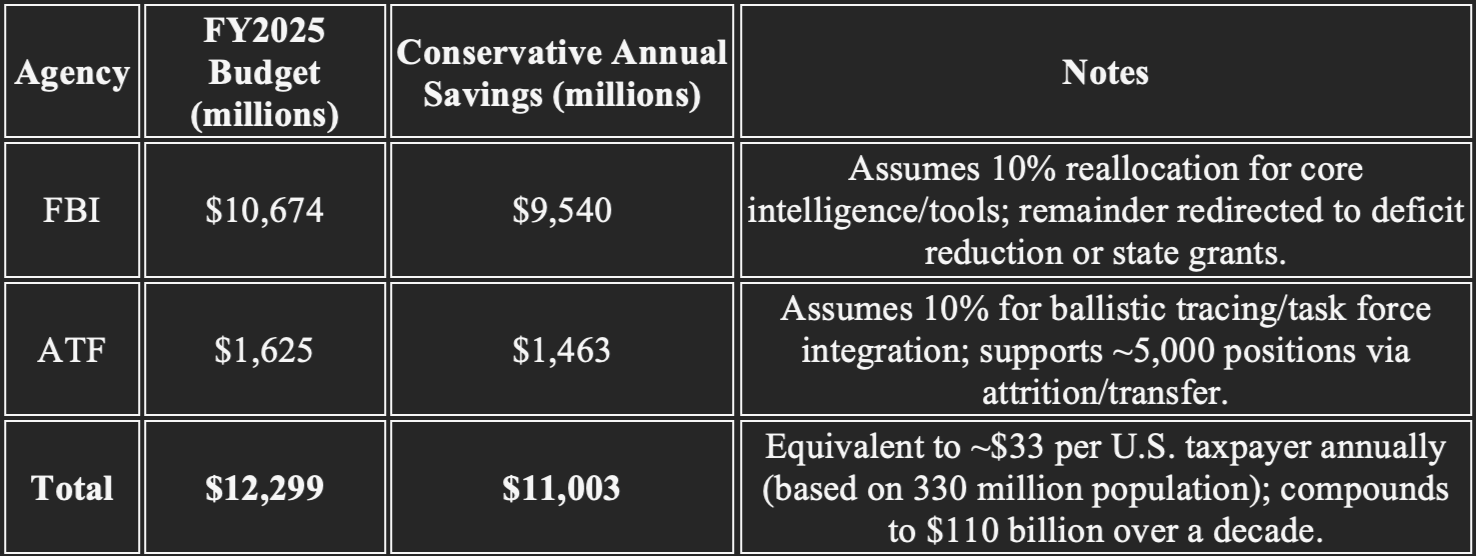
These figures err on the side of caution, excluding potential efficiencies from reduced overhead (e.g., duplicated facilities at $30 million for FBI). Historical context bolsters optimism: FBI funding rose 5.6% from FY2023 to FY2024 yet overlaps persisted; elimination could reverse such escalations, especially with the FY2026 request signaling $10.1 billion for FBI alone.
A Balanced Path Forward
An argument can be made that the FBI and ATF have delivered tangible results, from thwarting terror plots to tracing thousands of crime guns yearly, earning bipartisan praise for bravery in crises. Their elimination risks short-term disruptions, necessitating robust congressional oversight during transition. Yet, in pursuing fiscal responsibility without compromising safety, streamlining these agencies represents a pragmatic step. By pruning redundancies, the federal government can honor its core values: fidelity to efficient stewardship of public funds, bravery in reforming outdated structures, and integrity in delivering value to the American people. Lawmakers should prioritize this debate in upcoming appropriations, ensuring law enforcement evolves to meet 21st-century threats, leaner, smarter, and more accountable.
For sources and references, CLICK HERE
Disclaimer: The views, opinions, and conclusions expressed in this article are solely those of the author and do not necessarily reflect the views, policies, or positions of The DP Show, its owners, editors, or any affiliated organizations or individuals. This piece is for informational and entertainment purposes only and does not constitute legal, financial, medical, or professional advice of any kind. Readers are encouraged to conduct their own research and consult qualified professionals for guidance on any matters discussed.
